A personal rabbit hole
Lately, I have been exploring neuroscience and machine learning out of curiosity. Somewhere along the way, a question took hold:
What if we could create conscious artificial personas?
I am interested in what might happen if we combined richer neural dynamics, physical randomness and feedback about a system’s own internal state. This is a hypothesis to explore, rather than a claim that I have built such a system.
A neuron is more than a weighted sum
Many familiar artificial neural networks simplify a neuron to a weighted sum followed by a nonlinearity. These operations map well to parallel hardware such as GPUs. That makes me wonder how much our tools shape the models we choose to build.
Biological neurons have branching dendrites, ion channels and dynamics that unfold over time. Their response depends on more than a static list of inputs. Under some modeling conditions, approximating the behaviour of a single neuron can require a multilayer artificial network; that is not a universal conversion between biological and artificial neurons.
This difference is what makes more detailed mathematical models interesting to me.
The Hodgkin–Huxley model
The Hodgkin–Huxley model describes how membrane voltage evolves with ionic currents and voltage-dependent gating. Its variables are coupled: voltage changes the gate dynamics, and the gates change the currents that influence voltage.
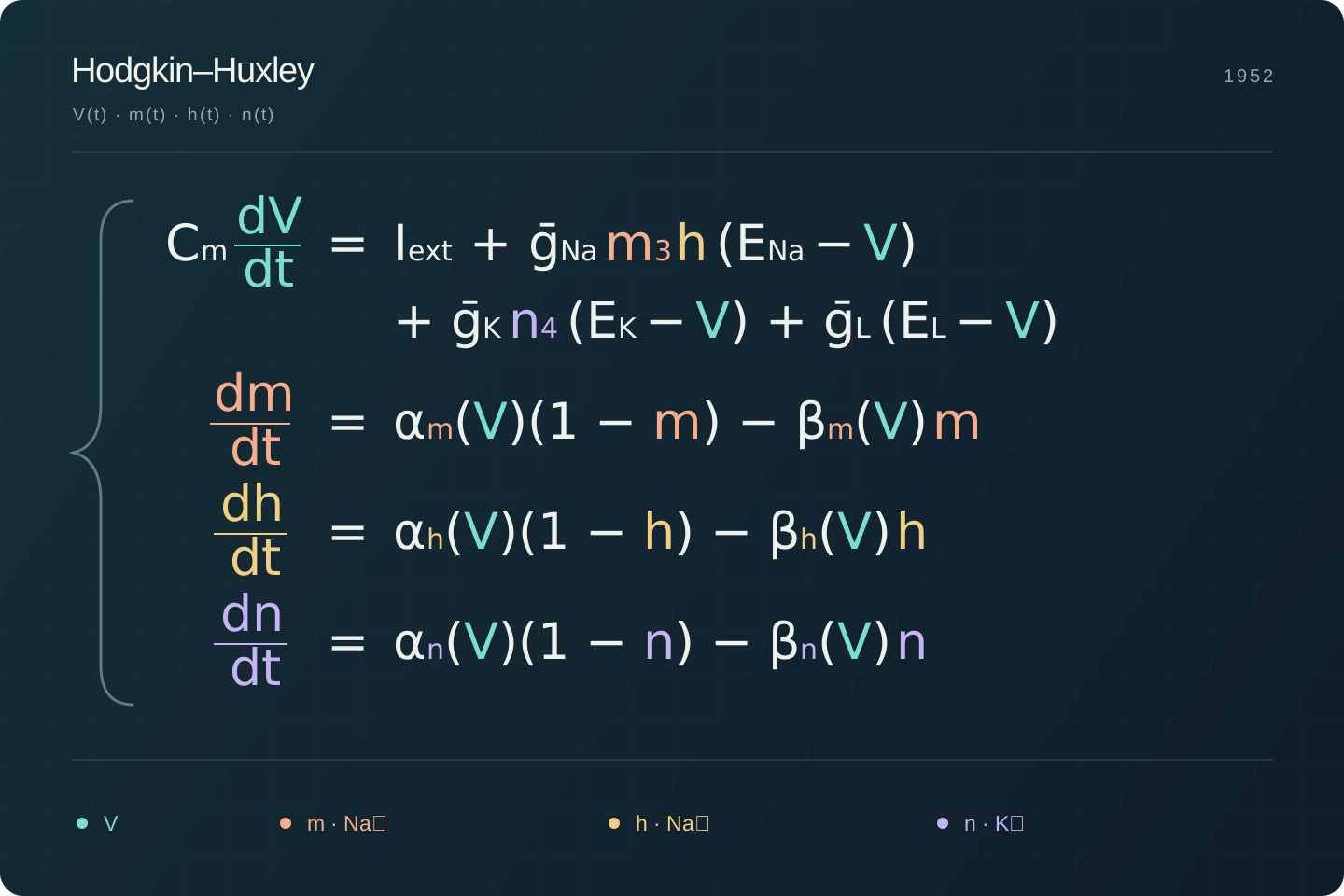
Here, V is membrane potential, Cₘ is membrane capacitance, and Iₑₓₜ is an applied current, using quantities per unit membrane area. The barred conductances are maximal conductances; E denotes the corresponding reversal potentials. The variables m and h describe sodium activation and inactivation, while n describes potassium activation. Their rates, α and β, depend on voltage.
The illustrated equations are deterministic. Given the same initial state, input and parameters, they determine the same trajectory. Fluctuations in finite populations of ion channels require an additional stochastic description.
What if randomness were physical?
In biology, fluctuations arise in molecular processes, ion-channel gating and synaptic transmission. They are part of the system we are trying to understand.
That led me to another question: what if a neural model received randomness from a physical quantum process, rather than only a pseudorandom sequence?
Could that combination produce something interesting beyond a different pattern of spikes or decisions? Could randomness, together with the right architecture, contribute to an emergent property such as self-awareness?
I do not know. The possibility is what prompted the idea. A quantum random-number source would supply samples to a model; it would not, by itself, turn the model into a quantum computer or demonstrate consciousness.
Three directions behind the idea
- Unpredictability within structure. A structured dynamical system can respond differently across trials when its random inputs differ. I am curious about the interaction between stable internal organization and variable trajectories, rather than variability alone.
- Emergent complexity. The Lorenz attractor is a useful reminder that simple deterministic equations can generate complex, sensitive behaviour. It does not require randomness. My analogy concerns the gap between simple rules and complicated outcomes, not evidence that chaos implies consciousness.
- Self-observation and feedback. What changes if a system can represent its own state and use that representation to influence later activity? This also brings to mind hippocampal replay during sleep and its relationship with memory. Replay, internal monitoring and subjective self-awareness remain different questions.
Questions worth asking
This began as an idea that appeared while I was learning. It might lead nowhere, but it gives me concrete questions to investigate:
- Could combining physical randomness with neural dynamics contribute something that the same architecture with pseudorandom inputs does not?
- What would have to be held constant to compare those systems fairly?
- What evidence could distinguish a useful internal self-model from a system that merely produces convincing self-descriptions?
- Which theories of consciousness support this direction, and which challenge it?
The title names a possible direction. The equations above model electrical excitability; they do not supply a mathematical definition or test of consciousness.
Inspired by Artem Kirsanov’s videos.
Technical context and research
These references put the idea in context; they do not establish that the proposed combination would be conscious.
- Electrical dynamics. Hodgkin and Huxley (1952) developed a quantitative model of membrane currents and excitation in the squid giant axon. The illustration uses a modern voltage convention with an explicit applied-current term.
- Single-neuron complexity. Beniaguev, Segev and London (2021) trained deep networks to approximate biophysical neuron models. Their result concerns a particular input/output mapping, not a claim that every neuron is literally a deep network.
- Where to add noise. Goldwyn and Shea-Brown (2011) examine how stochastic channel fluctuations can be incorporated into Hodgkin–Huxley equations. The location and statistics of the noise matter.
- Physical and pseudorandom sources. Ma et al. (2016) review quantum random-number generation and its device assumptions. As a modeling argument, sources with the same relevant statistical law can produce the same distribution of simulated outcomes; their physical origin alone would not establish a new neural capability.
- Chaos is not randomness. Lorenz (1963) studies deterministic nonperiodic flow and sensitivity to initial conditions. Unpredictability is not a sufficient test for consciousness.
- Replay during sleep. Wilson and McNaughton (1994) observed reactivation of hippocampal ensemble activity in rats during sleep. This supports a memory-related mechanism, not an equivalence between replay and self-awareness.
- Assessing consciousness. Butlin et al. (2023) derive candidate indicators from several theories of consciousness. They offer a more specific research framework than treating randomness, complexity or verbal self-report as proof.